If you have recently been diagnosed with Obstructive Sleep Apnea (OSA), you likely find yourself at a treatment crossroads. For years, the default answer was a machine that pumps air through a mask, but modern dentistry has introduced a quieter alternative. When weighing an oral appliance vs cpap, many patients are eager to know if they can avoid the “Darth Vader” mask while still protecting their heart and brain health. Many wonder, can a oral appliance help with sleep apnea as effectively as the gold-standard machine? The answer depends on your specific anatomy and the severity of your condition. To determine oral appliance effectiveness, clinicians look at your Apnea-Hypopnea Index (AHI) and your ability to stay compliant with treatment. Whether you choose an oral appliance or mouth guard, including a sleep apnea mouth guard, or stick with the traditional machine, the goal is consistent oxygenation. Finding the right mouth guard for sleep apnea requires a professional fitting, and selecting a properly designed sleep apnea mouth guard can significantly improve comfort and results, but the comfort levels often surpass that of a CPAP. In this guide, we will explore the science of sleep-disordered breathing to help you decide which path to restorative rest is right for your lifestyle.
Sleep Apnea Mouth Guard vs CPAP: Which is More Effective?
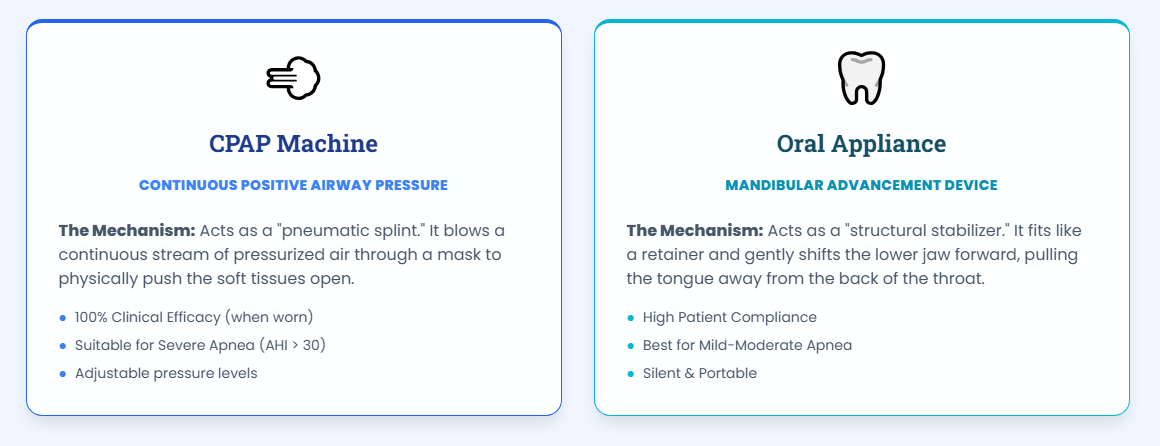
The question of effectiveness is not just about which device has the “strongest” mechanism, but which device you will actually use every single night. In clinical settings, Continuous Positive Airway Pressure (CPAP) is technically 100% effective at keeping the airway open when it is worn correctly. However, a significant percentage of patients struggle with mask leaks, skin irritation, and the sound of the motor.
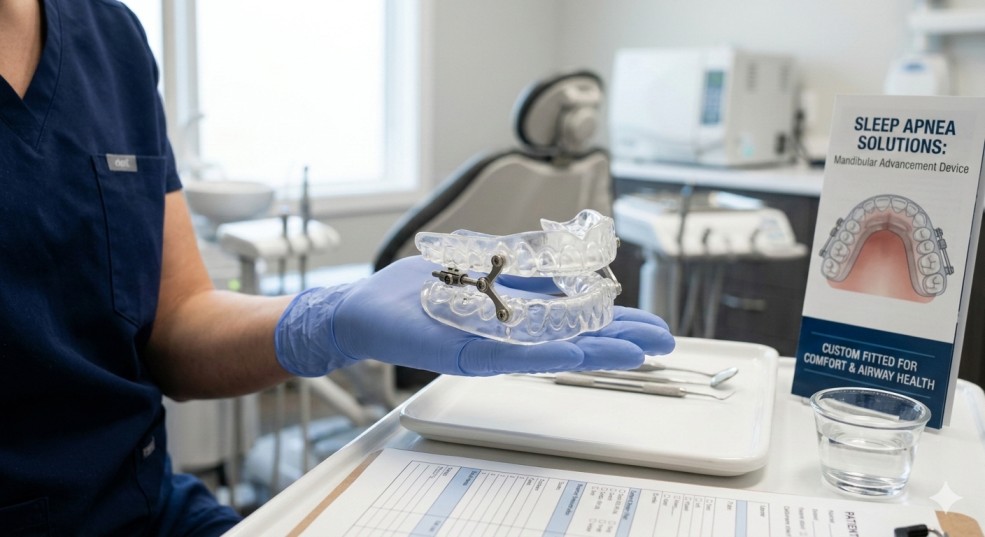
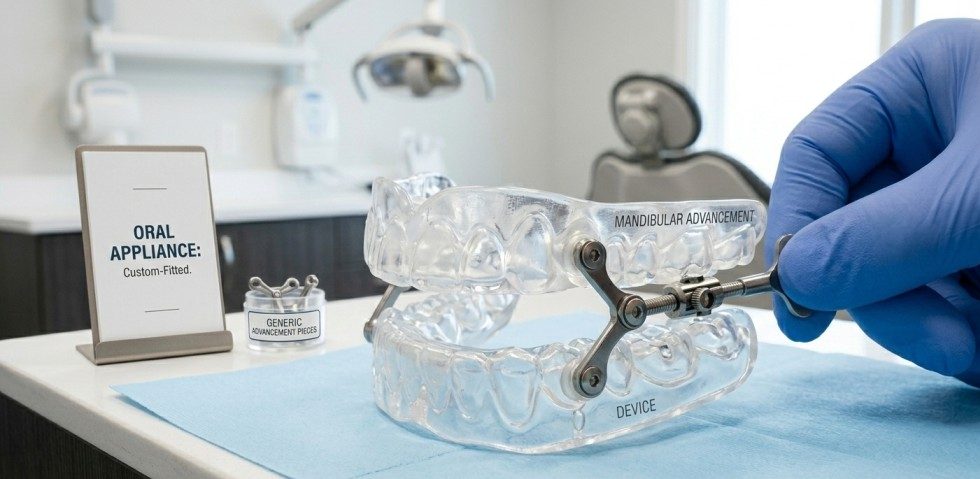
Conversely, a mouth guard for sleep apnea works by Mandibular Advancement. It gently shifts your lower jaw forward, creating a structural clearance at the back of the throat. While it may not provide the same pneumatic pressure as a CPAP, its high rate of patient compliance often makes it more effective in a “real-world” setting. If a machine is sitting in the closet because it’s uncomfortable, its effectiveness is zero.
How a Mouth Guard for Sleep Apnea Resolves Obstructions
To understand how a dental device works, we must look at the “plumbing” of the throat. During sleep, gravity causes the soft palate and the tongue to collapse toward the spinal column. For many, this is the primary cause of snoring and breathing pauses.
A custom-molded Mandibular Advancement Device (MAD) acts as a structural stabilizer. By maintaining the jaw in a slightly protruded position, it keeps the tongue from falling back. This mechanical solution is often enough to resolve mild to moderate cases of OSA. If you are unsure of your current severity, the first step is always to complete an at home sleep test to establish your baseline AHI.
Oral Appliance vs CPAP: Comparing the Clinical Data
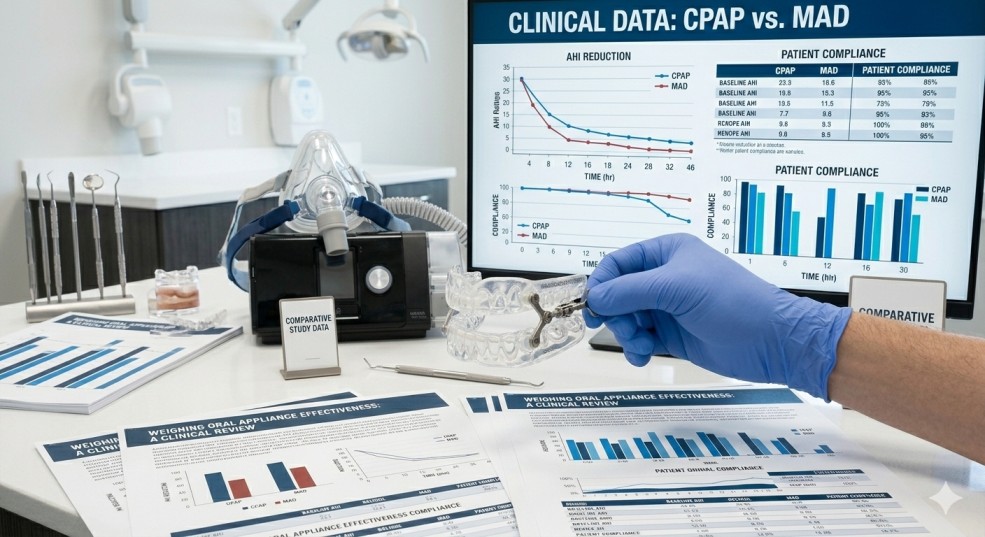
When we look at the clinical comparison of oral appliance vs CPAP, the results are fascinating. A study published by the American Academy of Sleep Medicine (AASM) suggests that while CPAP is superior at reducing the AHI to near-zero levels, oral appliances are often just as effective at reducing daytime sleepiness and lowering blood pressure in patients with mild to moderate apnea.
The “mean disease alleviation” is a metric used to measure the total benefit a patient receives. Because patients tend to wear their dental appliances for more hours per night than they wear their CPAP masks, the total amount of “treated sleep” is often higher with the oral device.
Oral Appliance Effectiveness in Mild to Moderate Cases
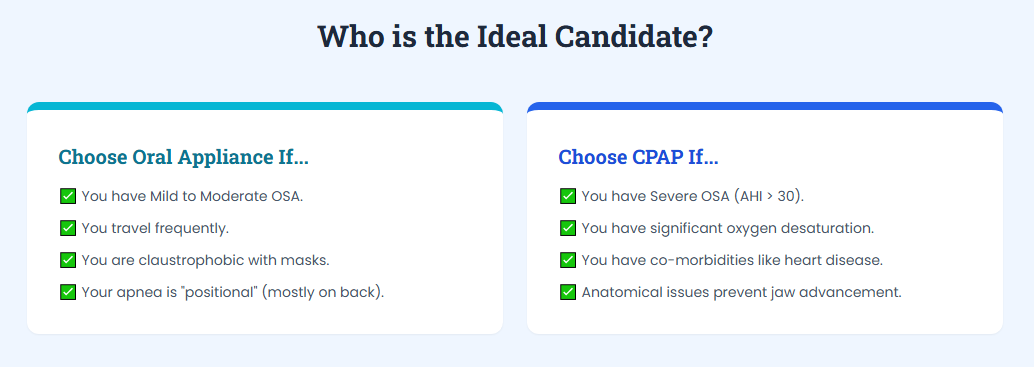
For those on the lower end of the apnea spectrum, a dental device is frequently the first recommendation. It is non-invasive, silent, and requires no electricity. It is particularly effective for “positional” sleep apnea—where the breathing issues primarily occur when the patient is lying on their back.
However, for severe cases (an AHI over 30), CPAP remains the undisputed leader. If your airway collapse is severe enough that mechanical jaw advancement isn’t sufficient to clear the path, the pneumatic “splint” provided by pressurized air is necessary to prevent dangerous drops in oxygen.
Choosing an Oral Appliance or Mouth Guard: The Comfort Factor
One of the biggest hurdles in sleep medicine is claustrophobia. Many patients feel panicked by a mask covering their nose and mouth. This is where choosing an oral appliance or mouth guard shines. The device feels much like a sports mouthguard or an orthodontic retainer.
There are two main types of dental devices:
- Mandibular Advancement Devices (MADs): The most common, which move the jaw forward.
- Tongue Stabilizing Devices (TSDs): Which use suction to keep the tongue forward.
Beyond comfort, portability is a major factor. Travelers often prefer a device that fits in a pocket over a machine that requires a dedicated carry-on bag and distilled water. For many, this convenience leads to 100% compliance, which is the ultimate goal of any sleep therapy.
CPAP Benefits: Why It Remains the Clinical Standard
Despite the rise of dental devices, the CPAP is not going anywhere. It is the most versatile treatment because it can be adjusted to any pressure level. If you gain weight, or if your apnea worsens over time, a technician can simply increase the air pressure on your machine. A dental device is limited by the physical range of your jaw’s movement.
Furthermore, modern CPAP machines have integrated humidifiers and “auto-ramp” features that make the transition to sleep much smoother than older models. If you are a long-term user, ensuring you have an up-to-date CPAP prescription is vital for maintaining the highest quality of care and accessing the latest mask technology.
Can a Oral Appliance Help with Sleep Apnea Long Term?
A common concern is whether the jaw will be permanently affected by wearing a dental device. While some patients experience slight “morning tooth awareness” or minor shifts in their bite, these are usually manageable under the supervision of a qualified sleep dentist.
To maximize the longevity and success of your treatment, many doctors recommend adjunct therapies. For example, performing specific exercises for sleep apnea can strengthen the muscles of the throat and tongue, making the oral appliance even more effective at keeping the airway clear. By combining muscle toning with mechanical advancement, you create a dual-layered defense against airway collapse.
Frequently Asked Questions
Is a sleep apnea mouth guard the same as a night guard for grinding?
No. A night guard for bruxism (grinding) only protects the surfaces of the teeth. A mouth guard for sleep apnea is designed to physically move the mandible (lower jaw) forward to open the airway. A standard grinding guard will not treat sleep apnea.
Can I get an oral appliance over the counter?
While “boil and bite” options exist, they are generally not recommended for treating a serious medical condition like OSA. Custom-fitted appliances are far more effective, more comfortable, and less likely to cause jaw joint (TMJ) issues.
How do I know if I’m a candidate for an oral appliance?
The gold standard for candidacy is a sleep study. If your results show mild to moderate apnea, you are likely a candidate. If you have severe apnea or low oxygen saturation, your doctor will likely insist on CPAP first.
How long do sleep apnea mouth guards last?
With proper care and cleaning, a high-quality, custom-molded oral appliance can last between 3 to 5 years.
Conclusion
Choosing between an oral appliance and a CPAP machine is a personal decision that should be made in consultation with a sleep specialist. While the CPAP remains the most powerful tool for severe cases, the oral appliance effectiveness in mild to moderate patients cannot be overstated. Its combination of silence, portability, and high comfort levels makes it an ideal solution for those who cannot tolerate the mask.
Whether you opt for a machine or a custom mouth guard for sleep apnea, the most important step is moving from “guessing” to “knowing.” Untreated sleep apnea is a significant stressor on the cardiovascular system. By taking action today, you are investing in a future of clarity, energy, and long-term health.
Don’t let another night go by in a fog of exhaustion. The first step toward the right treatment is an accurate diagnosis.
Order your At-Home Sleep Apnea Test today and get the clinical data you need from the comfort of your own bed.
Authoritative References

Dr. Kunal Agarwal is a highly accomplished board-certified physician specializing in Family Medicine, Sleep Medicine, and Obesity Medicine. He completed his residency at Michigan State University and a fellowship at Henry Ford Health System, and has over a decade of experience delivering exceptional patient outcomes. Dr. Argarwal is passionate about patient education and advocacy, sleep disorders, and more. His expertise in treating sleep apnea is extremely valuable to improve his patients’ lives.
Awards, Honors, & Recognition
Top Doctor
SRQ Magazine and Sarasota Magazine, 2023-2024
Fellow of American Academy of Sleep Medicine (FAASM)
American Academy of Sleep Medicine, 2021
Named “Top Doctor” for 2017, 2018 (on cover), 2019,and 2020 by Delaware Today Magazine
2017-2020