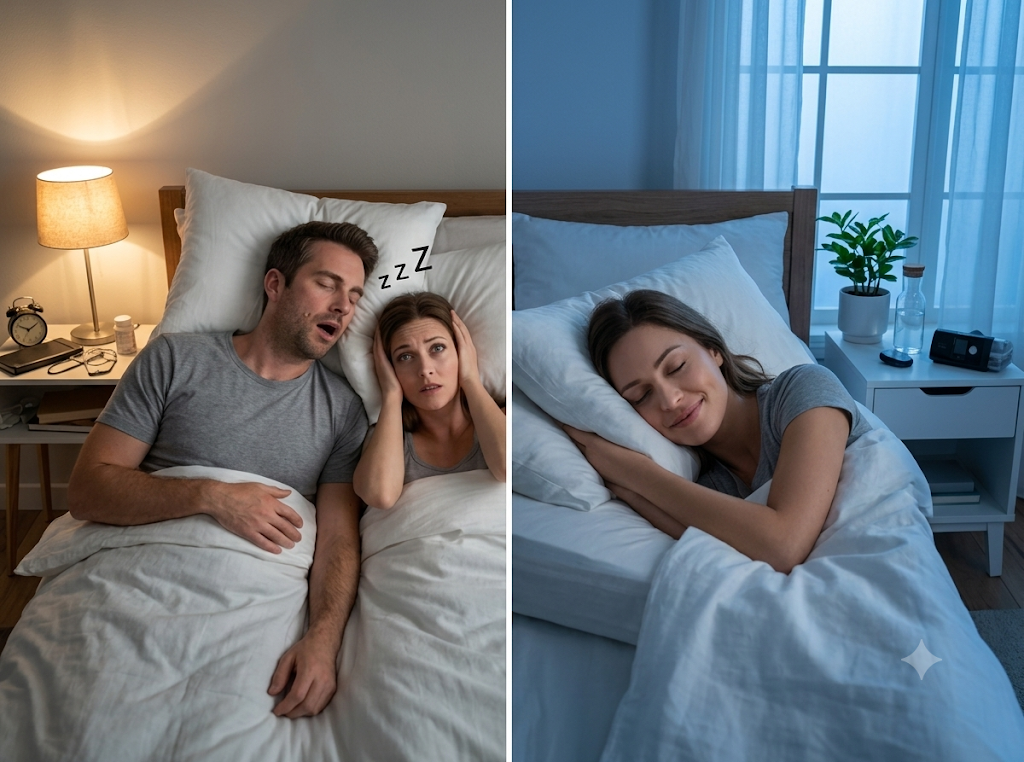
It’s 3:14 AM. You are lying awake, staring at the ceiling, calculating exactly how many hours of sleep you’ll get if you fall asleep right now. Meanwhile, two inches to your left, your partner is snoring with the rhythmic, ear-splitting volume of an industrial woodchipper.
You love them. You really do. But in this dark, exhausting moment, you are also quietly drafting a very reasonable argument for moving into the guest bedroom. Permanently!
If this sounds familiar, you might be a prime candidate for a sleep divorce. Despite the terrifyingly dramatic name, it doesn’t involve lawyers, splitting the furniture, or fighting over who keeps the dog. A sleep divorce simply means a committed couple chooses to sleep in separate beds — or separate rooms — to get a better night’s rest.
And it is far more common than you’d think. According to a survey by the American Academy of Sleep Medicine (AASM), over one-third of Americans report occasionally or consistently sleeping in a separate room from their partner [1]. So no, you are not alone — and no, it does not mean your relationship is falling apart.
But before you pack your pillows and declare a unilateral bedroom treaty, there’s something important you should know. The snoring that’s driving you to the couch may not be just an annoying habit. It might be a medical emergency in slow motion.
What Your Partner’s Snoring Is Actually Doing to Your Brain
To understand why people, choose separate sleeping arrangements, you have to look at what disrupted sleep is physically doing to the person lying awake next to the woodchipper.
Our bodies need uninterrupted cycles of deep sleep and REM (Rapid Eye Movement) sleep to regulate hormones, repair muscle tissue, and consolidate memories. When your partner tosses, turns, or snores, they aren’t just annoying you — they are actively ejecting you from the restorative stages your brain depends on.
A study published in the Journal of Behavioral Medicine found that sleep fragmentation — being woken up multiple times throughout the night — can be just as damaging to mood, cognitive function, and daytime performance as skipping sleep entirely [2]. Your immune system weakens. Your blood pressure climbs. Your emotional regulation deteriorates. And you become the kind of person who googles “what is sleep divorce” at 3:14 AM.
So yes, moving to a quiet room might literally save your health. But it might also be quietly delaying a diagnosis your partner desperately needs.
Weighing the Scale: Sleep Divorce Pros and Cons
Like any significant lifestyle shift, breaking up your bedtime routine comes with real trade-offs. Here’s a clear-eyed look at both sides.
The Pros: Better Health and Less Resentment
- Deeper, restorative sleep: The most obvious benefit is a dramatic upgrade in sleep quality. When you sleep through the night, your immune system strengthens, your focus sharpens, your blood pressure stabilizes, and your cardiovascular markers improve. Consistent, uninterrupted sleep also reduces inflammatory markers and supports better glucose regulation — meaningful health outcomes that go well beyond feeling less tired.
- The end of midnight resentment: It is incredibly difficult to be patient and present with your spouse at breakfast when you spent the entire night silently blaming them for your misery. Sleeping apart removes that friction and lets you actually like each other again during daylight hours.
- Customized sleep environments: If you like the room at a crisp 65°F with a ceiling fan and blackout curtains, but your partner wants a 74°F oasis with a white noise machine and three extra blankets, separate rooms mean you both win.
The Cons: What You Risk Losing
- Loss of spontaneous connection: Bedtime is often the only unscheduled window busy couples must connect — to talk, to decompress, to be close. Moving to separate spaces requires you to be far more intentional about creating that time, or it quietly disappears.
- The social stigma: Friends and family may assume your relationship is struggling if they find out you sleep apart. That perception — even if it’s completely wrong — can add unwanted pressure.
- The risk of avoidance: This is the most clinically important downside. When the symptom (your disrupted sleep) is temporarily resolved by moving rooms, the underlying cause — which may be a serious breathing disorder — never gets addressed. You feel better. Your partner keeps stopping breathing. Nobody wins.
The Elephant in the Bedroom: Is It Snoring, or Sleep Apnea?
A sleep divorce can provide immediate, genuine relief. But if the primary reason you are considering it is because your partner’s snoring is loud enough to rattle the windows, moving down the hall is treating the symptom — not the condition.
Loud, chronic snoring is one of the most prominent warning signs of sleep apnea — a serious medical disorder in which breathing repeatedly stops and starts during sleep. There are different types of sleep apnea, ranging from Obstructive Sleep Apnea (where the airway physically collapses) to Central and Complex Sleep Apnea, each with distinct causes and treatment pathways.
The most common triggers are excess body weight, anatomical airway narrowing, and the relaxation of throat muscles during deep sleep — factors that don’t resolve by relocating to the guest room. You can read more about the main causes of sleep apnea here.
Left untreated, sleep apnea dramatically elevates the risk of high blood pressure, type 2 diabetes, heart disease, atrial fibrillation, and stroke. These are not theoretical long-term risks. They compound quietly, year by year, while everyone in the house gets less sleep than they need.
One more thing worth knowing: sleep apnea in women often presents without loud snoring. A partner’s complaint about disrupted sleep is sometimes the only early warning sign available. If your partner is gasping for air, choking, or waking up exhausted despite having eight hours in bed, they need a medical evaluation — not just a ticket to the guest room.
Not sure if it’s snoring or sleep apnea?
Take a quick clinical screening — it takes less than 5 minutes and gives you a clear next step.
How to Handle a Sleep Divorce Without Losing the Romance
If you choose to sleep apart, clinical experts suggest treating it as a functional health tool rather than an emotional verdict. Journal Chronobiology International found that healthy relationship satisfaction relies heavily on the quality of waking interactions — meaning a well-rested couple sleeping in separate rooms often communicates better than an exhausted couple sharing a mattress.
The key is intentionality. Here’s how to make it work:
- Protect a wind-down window together. Spend time in the same bed reading, talking, or watching a show before you move to your respective rooms for actual sleep. This preserves closeness without sacrificing rest.
- Keep the conversation open. Make sure your partner understands that the choice is driven by biology and health, not a retreat from affection. This conversation is worth having early and often.
- Treat it as flexible, not permanent. Use it as a functional solution you revisit and adjust based on how you both feel — not a new household rule set in stone.
- Get screened together. If snoring is the reason you’re sleeping apart, frame the home sleep test as a shared decision rather than an accusation. It removes the “you’re the problem” dynamic entirely and gives both of you real clinical answers.
Frequently Asked Questions
Does a sleep divorce mean our relationship is in trouble?
Absolutely not. For many couples, it saves the relationship. Prioritizing healthy rest means you show up for your partner with more patience, emotional energy, and genuine affection during the day. Think of it as an act of mutual care — not a white flag.
How common is sleep divorce in the US?
More common than most people admit. According to the American Academy of Sleep Medicine, roughly 35% of adults in the United States sleep in separate rooms occasionally or consistently. It spans all age groups and relationship stages.
How do we know if it’s just snoring or something more serious?
Occasional snoring is common. The warning signs that point toward sleep apnea are consistent, loud snoring accompanied by gasping or choking sounds, followed by daytime exhaustion and morning headaches regardless of sleep duration. If that pattern sounds familiar, a clinical screening is the right next step. SleepCare Online’s home sleep test delivers a physician-reviewed diagnosis in your own bed, without a lab visit.
Don’t Just Separate — Find a Real Solution
A temporary sleep divorce can provide immediate, desperate relief for a sleep-deprived partner, and that relief is real and legitimate. But a close look at the pros and cons reveals a clear gap: escaping the noise doesn’t fix your partner’s underlying breathing. If a sleep disorder is the true culprit, moving down the hall is simply delaying a health crisis that requires clinical attention.
The good news is that this problem is genuinely solvable. CPAP therapy has one of the highest treatment satisfaction rates of any chronic condition — most patients report dramatic improvements in sleep quality, energy, and mood within the first week of use. A diagnosis isn’t a burden; it’s the beginning of actually sleeping again.
With SleepCare Online, your partner can complete an at-home sleep test in their own bed — no lab visit, no overnight stay, no complicated equipment setup. Our board-certified sleep physicians analyze the data, provide a formal diagnosis, and connect your partner with an effective, personalized treatment plan.
Don’t let sleep apnea decide where you sleep. Address the root cause today, and get back to sharing the same room — in blissful, quiet peace.
References
[1] American Academy of Sleep Medicine (AASM). (2023). AASM Sleep Prioritization Survey: Over one-third of Americans opt for a ‘sleep divorce.’
[2] Journal of Behavioral Medicine. (2014). The cumulative effects of sleep restriction and sleep fragmentation on daytime cognitive performance and emotional regulation.

Chris Vasta is the President of The CPAP Shop and a leading authority in sleep and respiratory therapy. With years of hands-on experience in the industry, Chris collaborates closely with top manufacturers and offers expert insights that help shape the design and performance of new CPAP products. He is frequently sought after to evaluate prototypes, provide professional reviews of new releases, and share his expertise to help patients and clinicians make informed decisions about sleep therapy solutions.
As the President of The CPAP Shop, Chris works hard to make sure every customer’s needs are met by stocking hundreds of the highest quality CPAP items. He understands the challenge sleep apnea brings to patients and is dedicated to improving the quality of our customer’s lives.