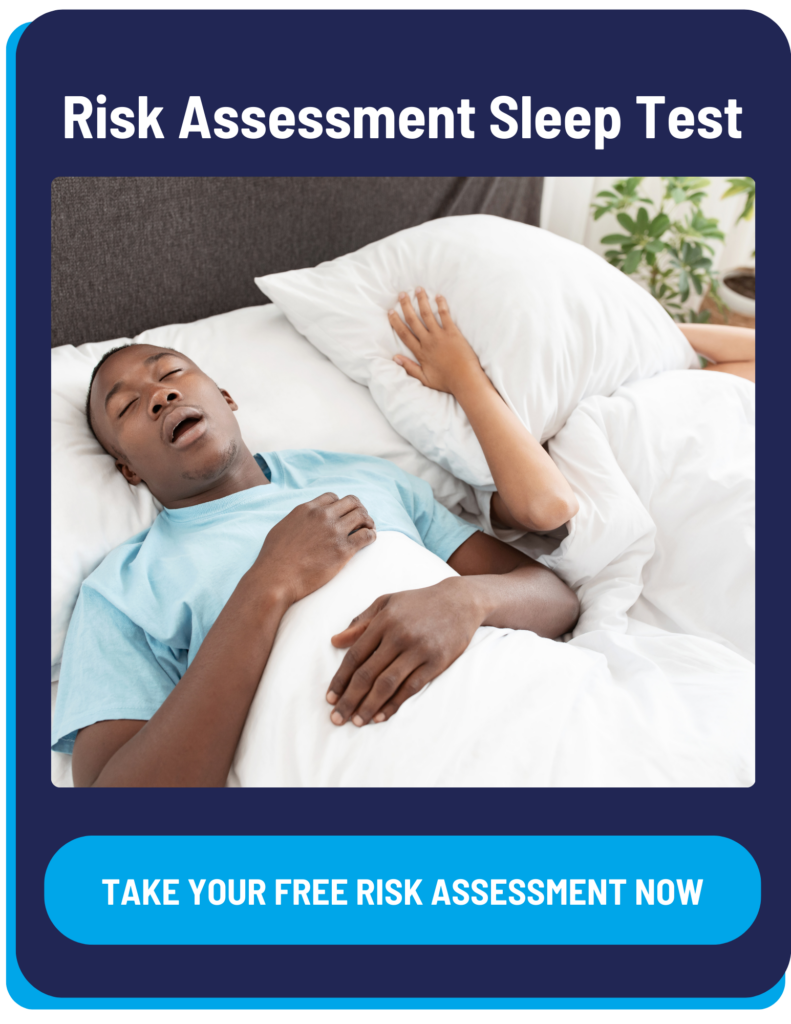
Do you regularly find yourself fighting the urge to doze off during an afternoon meeting, while reading, or even while sitting in traffic? Persistent fatigue is more than just a byproduct of a busy lifestyle; it can indicate an underlying clinical condition. To quantify this fatigue, sleep specialists rely on the excessive daytime sleepiness scale, a validated diagnostic standard used to measure chronic exhaustion. If you are experiencing the common symptoms of excessive daytime sleepiness, taking a proactive daytime sleepiness test is a critical first step.
Uncovering why you are exhausted requires structured evaluation. Utilizing an online excessive daytime sleepiness test can clarify whether your fatigue stems from poor sleep hygiene or a sleep-related breathing disorder like obstructive sleep apnea (OSA). For individuals scoring high on an excessive daytime sleepiness scale, clinical screening no longer requires an inconvenient, overnight hospital stay. Transitioning from a self-assessment to an intuitive at home sleep test provides a accurate, discrete pathway to pinpointing the root cause of your fatigue from the comfort of your own bed.
Understanding the Symptoms of Excessive Daytime Sleepiness
Before utilizing clinical metrics, it is vital to distinguish between occasional tiredness and chronic hypersomnia. True sleepiness is characterized by a persistent, baseline inability to remain alert during the primary waking hours of the day.
Common Indicators and Behavioral Signs
The physical and cognitive manifestations of chronic exhaustion often develop gradually, making them difficult for patients to recognize immediately. Key indicators include:
- Involuntary Dozing: Frequently nodding off during passive activities such as watching television, reading, or riding as a passenger in a vehicle.
- Cognitive and Memory Deficits: Noticing a distinct lack of focus, brain fog, reduced processing speed, and difficulty retaining short-term information.
- Mood Fluctuations: Experiencing increased irritability, heightened anxiety, or a depressive mood baseline due to neurological fatigue.
- Morning Headaches and Dry Mouth: Waking up with a dull, throbbing headache or an intensely dry throat, which are classic signs of airway resistance.
When these signs manifest regularly, they point to a disruption in sleep architecture, often caused by a fluctuating respiratory rate while sleeping.
Decoding the Excessive Daytime Sleepiness Scale
To translate subjective exhaustion into quantifiable clinical data, sleep medicine relies on standardized scoring systems. The most universally recognized framework is the Epworth Sleepiness Scale (ESS), developed to assess a patient’s probability of falling asleep across diverse daily environments (Johns, 1991).
How the Scoring Model Works
The assessment asks individuals to rate their likelihood of dozing off in eight specific, everyday scenarios on a scale from 0 (would never doze) to 3 (high chance of dozing). These scenarios include:
- Sitting and reading
- Watching television
- Sitting inactive in a public place (e.g., a theater or a meeting)
- As a passenger in a car for an hour without a break
- Lying down to rest in the afternoon when circumstances permit
- Sitting and talking to someone
- Sitting quietly after a lunch without alcohol
- In a car, while stopped for a few minutes in traffic
Analyzing Your Score Results
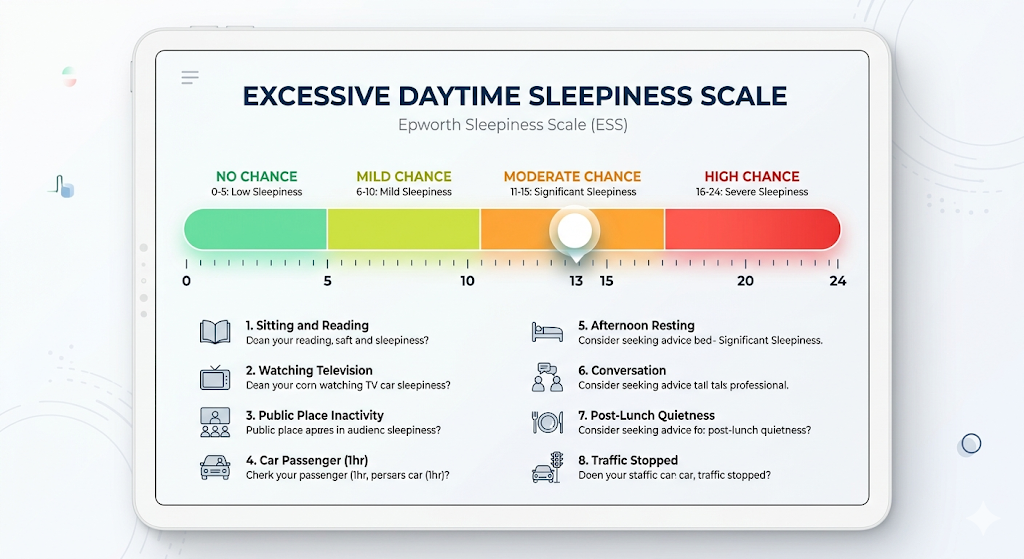
The total points accumulate to provide an objective snapshot of a patient’s neurological sleep debt:
- 0 to 5 Points: Lower normal daytime sleepiness.
- 6 to 10 Points: Higher normal daytime sleepiness.
- 11 to 12 Points: Mild excessive daytime sleepiness.
- 13 to 15 Points: Moderate excessive daytime sleepiness.
- 16 to 24 Points: Severe excessive daytime sleepiness.
A score of 11 or higher serves as an immediate clinical indicator that further objective testing is necessary to rule out sleep-disordered breathing. Additionally, high ESS scores have been linked to narcolepsy or idiopathic hypersomnia.
Why an At-Home Test Is the Logical Next Step
If a self-assessment reveals a high probability of hypersomnia, the next logical milestone is a formal diagnostic evaluation. For the vast majority of patients, an accessible home-based test is the ideal alternative to a traditional hospital lab.
Eliminating the Friction of Clinical Labs
Traditional polysomnography requires spending a night in a foreign hospital bed, tethered to dozens of electrodes while being observed via video monitor. This environment often triggers “first-night effect” insomnia, skewing true results. In contrast, home testing allows you to remain in your own bed, preserving your natural sleep hygiene and nightly routines.
Specialized, Lightweight Diagnostics
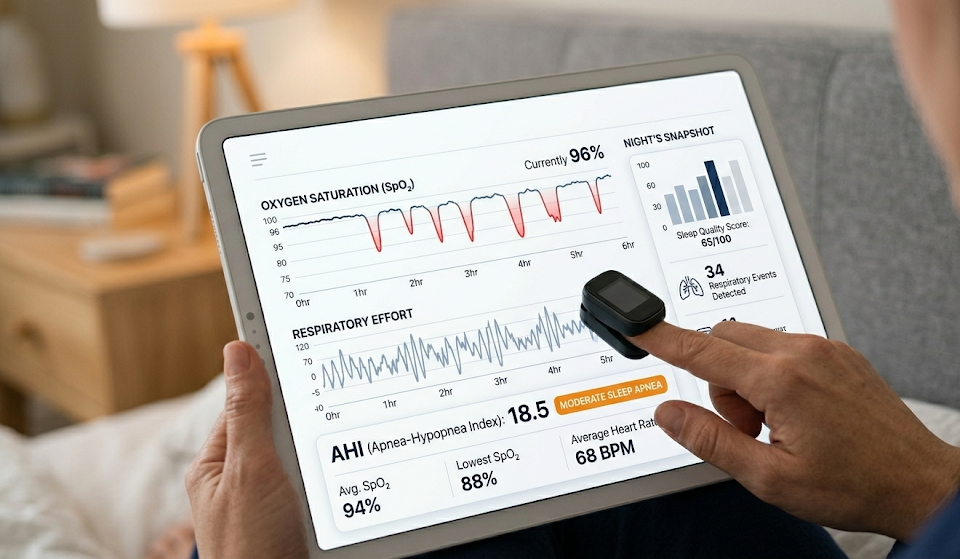
Modern home diagnostic kits utilize minimalist, advanced medical sensors designed to track the precise physiological markers of sleep apnea. These devices measure blood oxygen drops, heart rate variance, and changes in airflow. If a home test confirms obstructive sleep apnea, patients can explore a range of clinical interventions, from continuous positive airway pressure (CPAP) therapy to targeted physical conditioning, such as specialized exercises for sleep apnea, to improve airway muscle tone.
Frequently Asked Questions
What is the difference between fatigue and excessive daytime sleepiness?
Fatigue refers to a profound, overarching lack of physical or mental energy, often relieved by rest or lifestyle changes. Excessive daytime sleepiness, however, is a neurological compulsion to sleep. Individuals suffering from sleepiness will actively fall asleep if they sit quietly in a calm environment, whereas fatigued individuals feel exhausted but may not necessarily drift off to sleep.
Can lifestyle choices alone cause a high sleepiness score?
Yes. Chronic sleep deprivation, irregular work shifts, high caffeine consumption late in the day, or poor sleep environments can elevate your score. However, if your sleep duration is sufficient (7 to 9 hours per night) and you still score high on an excessive daytime sleepiness scale, it strongly suggests an intrinsic sleep disorder like sleep apnea or periodic limb movement disorder (PLMD) is fragmenting your sleep (Patel et al., 2018).
How accurate is an online sleepiness quiz compared to a medical test?
An online screening quiz is a subjective tool designed to measure the severity of your symptoms and identify if a problem exists. It does not provide a definitive medical diagnosis. A definitive diagnosis requires an objective medical device, such as a home sleep apnea test, to record actual physiological data while you sleep.
Conclusion
Measuring your fatigue through an excessive daytime sleepiness scale provides the objective clarity needed to stop guessing about your health. Ignoring the common signs of chronic exhaustion can lead to systemic complications, including increased cardiovascular strain, metabolic imbalances, and diminished cognitive performance.
Fortunately, identifying the underlying cause of your sleep fragmentation has never been easier. If a self-guided daytime sleepiness test confirms that your exhaustion levels are outside the healthy norm, don’t wait to seek answers. Take the next critical step toward reclaiming your energy, focus, and vitality by ordering a professional, comprehensive at home sleep test from SleepCare Online today.
References
- Johns, M. W. (1991). A new method for measuring daytime sleepiness: the Epworth sleepiness scale. Sleep, 14(6), 540–545. https://doi.org/10.1093/sleep/14.6.540
- Cited by: 11,450+
- Patel, A. K., Reddy, V., & Araujo, J. F. (2018). Physiology, Sleep Stages. StatPearls Publishing. https://www.ncbi.nlm.nih.gov/books/NBK526132/
- Cited by: 210+

Dr. Kunal Agarwal is a highly accomplished board-certified physician specializing in Family Medicine, Sleep Medicine, and Obesity Medicine. He completed his residency at Michigan State University and a fellowship at Henry Ford Health System, and has over a decade of experience delivering exceptional patient outcomes. Dr. Argarwal is passionate about patient education and advocacy, sleep disorders, and more. His expertise in treating sleep apnea is extremely valuable to improve his patients’ lives.
Awards, Honors, & Recognition
Top Doctor
SRQ Magazine and Sarasota Magazine, 2023-2024
Fellow of American Academy of Sleep Medicine (FAASM)
American Academy of Sleep Medicine, 2021
Named “Top Doctor” for 2017, 2018 (on cover), 2019,and 2020 by Delaware Today Magazine
2017-2020